

Brick Lane
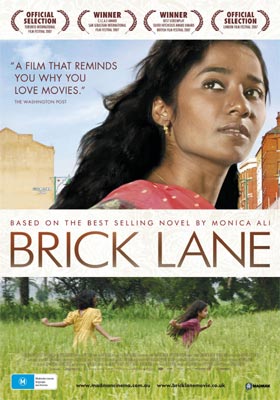
Thanks to Madman Cinema, here is your chance to win double passes to see 'Brick Lane'.
Cast:Nazneen - Tannishtha Chatterjee
Chanu - Satish Kaushik
Karim - Christopher Simpson
Shahana - Naeema Begum
Bibi - Lana Rahman
Razia - Harvey Virdi
Mrs Islam - Lalita Ahmed
Hasina - Zafreen
Director: Sarah Gavron
Running Time: 101 min
Release date: 20 March 2008
ABOUT THE FILM
A poetic adaptation of Monica Ali's award winning book, BRICK LANE tells the powerful story of one woman's journey from childhood in Bangladesh to East London - through a marriage, a family and finally to herself.
SYNOPSIS
Swing little girl on your swing. Comb your beautiful hair. Your bridegroom will come soon. And then he will take you away.
Nazneen and her sister Hasina play a game of chase, teasing each other whilst running through the vibrant green paddy fields of their Bangladesh village home. Reaching their house they see their mother sitting abject and alone. Nazneen's approach to her is rebuffed and she is drawn back to the fields to play with her sister. While they splash in the nearby stream with a group of local boys, their mother appears in the distance carrying a large pot. She walks towards the river and descends into it, ties a rope around her neck and fills the pot with water which instantly pulls her under, her red sari floating dramatically across the surface. Noticed by other women washing clothes nearby, the alarm is raised. Nazneen is attracted by the cries to push through the crowd and see her mother being dragged out of the water, dead.
Some time later, the sisters look out mournfully from the steps of their house, through the monsoon rain. Their father approaches and sternly tells them to go inside. A decision has been made.
Nazneen (now 17) resplendent in yellow sari and traditional wedding make-up is fussed over by the local women whilst Hasina (14) stands apart. Their father brings out a picture of the man Nazneen is to marry - an older man, far away, in London. The two sisters walk hand in hand to the river's edge, the golden sun illuminating Nazneen's sorrow as she steps on to the tiny boat that will take her away from her sister and home. Hasina turns and runs off as Nazneen drifts away, a single tear falling form her eye.
Sixteen years later, Nazneen walks down Brick Lane, a solitary figure carrying her shopping past familiar shops, the mosque and the curry houses, whilst the full ethnic mix of East London carries on its business around her. She turns into a dramatic red brick estate, walks across the courtyard, up the stairs and enters the flat which has now become her home, and home to her two daughters Shahana (14) and Bibi (10) and to her husband, Chanu.
Breakfast time and Chanu leaves for work, hopeful, in his indomitable fashion, that he will hear news of the promotion that he believes will finally vindicate his years of struggle for acceptance in England. A letter has arrived from Hasina. With Chanu and her daughters gone, Nazneen sits to read the latest tales of her sister's adventures in love back home in Bangladesh. Venturing out onto the walkway, she notices a new neighbour, Razia, talking to Mrs Islam, an older member of the community. Razia, although Bangladeshi, doesn't wear a sari and with her short hair and brash manner intrigues Nazneen. Razia moves her belongings, including a sewing machine, into her new flat. Shyly, Nazneen says hello and returns to her domestic chores. Chanu comes home defeated, as he has been passed over once again for promotion. He announces that he has resigned in protest. azneen's dreams of returning to Bangladesh to be with Hasina are shattered.
The following day, from her window, Nazneen sees a young British Bangladeshi man, Karim, bringing a fresh batch of sewing work to her new neighbour. 'Some of the women are sewing at home', Nazneen tells Chanu who completely ignores the comment and its implication. Later, running into Razia on the estate, she is invited back for tea and Razia generously gives Nazneen her old sewing machine. Nazneen realises she can help the family return to Bangladesh with her own efforts. Chanu reacts badly to the idea of his wife working and retires with a scowl to the bedroom taking the TV with him. A few days later, Karim, knocks at her door carrying the first batch of sewing for Nazneen. Karim is handsome and radiant with the idealistic energy of youth.
Over the next months as spring turns to summer, they talk and grow close. Karim introduces Nazneen to the outside world through the community meetings with which he is involved. She learns about him building local strength to defend the interests of the Bengali community against the racist organisations who are attempting to destabilise the area - namely one group, the Lionhearts.
One day, while Nazneen shops in the local market, Karim brushes past her and entreats her to follow him into his uncle's empty factory. Amongst the piles of sewing and the rows of machines, they kiss. Transformed by her first experience of love, Nazneen floats through the summer coping with the difficulties of her life: the debts that Chanu has incurred by borrowing money from Mrs Islam; the dissatisfaction of her teenage daughter Shahana - who is resisting the notion of moving to Bangladesh; and the letters from her sister which hint at troubles in love and life there.
Summer turns to autumn. Irrepressible as ever, Chanu has found a job as a taxi driver to 'raise money for the home fund' and a jolly family day out to Buckingham Palace heralds the end of a period of tranquillity. Walking down a sunny Brick Lane, Nazneen is glowing with hope and confidence as she sees her lover in the street. But as they near each other they are distracted by a crowd gathering to watch a TV screen inside a local café. They both turn to see the terrible spectacle of the second plane screaming into the Twin Towers and are brutally awoken from their relationship dream.
At home, as the family watch those fateful images over again, Chanu is more agitated than ever - fearful of a racist backlash and determined that now is the time to leave for Bangladesh. The days that follow are anxious for Nazneen as she copes with the fallout from 9/11. A series of incidents on the news and on the estate culminate in Chanu returning home unexpectedly to find Nazneen sewing and Karim in Chanu's seat at his computer. It is clear to Chanu what has been going on between them, but he makes a dignified exit.
Later that evening, in retaliation, Chanu confronts his wife with the truth about her sister's adventures in love - that she is living as a prostitute. The realisation of this truth provokes an emotional breakdown for Nazneen. Frantically she scours her sister's many letters. The names and phrases within them take on new meanings that trigger a flood of memories and images - of her sister, of Karim, of Chanu and of her mother's death. A collage of pain and the toll of years of endurance combine to bring on a dramatic physical collapse. When she wakes days later, the world appears to have returned to normality. Chanu is cheery - he has bought the tickets for Bangladesh and has started to pack. Karim is nowhere to be seen and the family is facing an uncertain future together.
As the winter progresses, the time to leave for Bangladesh draws ever closer and Shahana increasingly challenges her father's authority. Karim returns, now with a beard and the serious air of a more politicised Muslim. He offers Nazneen his hand in marriage as a way of legitimising their situation. Chanu then decides to attend one of the community meetings organised by Karim and asks Nazneen to accompany him. In this highly charged atmosphere, Chanu makes an emotional, personal statement about Islam and brotherhood which strikes a very different note to the prevailing radicalism of the meeting. Nazneen begins to understand the reality of both men. She loves them both in different ways, but her future is with neither. She meets Karim in the street and makes a final break with him. Returning to the estate, she sees Mrs Islam waiting at her door. Mrs Islam demands the money that Chanu owes her. A new and clearly empowered Nazneen resists, stating they have paid back much more than was borrowed. She challenges Mrs Islam to prove that she is not a usurer by swearing on the Koran. Mrs Islam threatens to reveal Nazneen's secrets to her husband, but is faced down by Nazneen who wins another significant battle to determine her fate.
As Chanu dismantles the last of the furniture, the boxes all packed ready to leave, Shahana confronts him with her passionate pleas to stay. This is their home - neither her, Bibi nor Nazneen want to live in Bangladesh. She urges her Mother for once in her life to voice her own wishes. When Nazneen does not, Shahana runs out of the flat and into the streets below. After a moment's hesitation, Nazneen follows in a dramatic chase through the night time streets. Distant memories of her childhood chases with her sister are evoked as she runs down Brick Lane and out into the City, ending in the neon lit glare of Liverpool Street Station. She clasps her daughter to her and, in that moment, it is clear to her that she should stay.
Nazneen tells Chanu that he must go but that she cannot. Tearfully and with great dignity he accepts the situation acknowledging her strength and still with a hope that they may be together in the future. The following day he leaves, alone, watched by Nazneen and their daughters as the first flakes of winter snow drift in the air.
Waking with her daughters in the empty flat, Nazneen looks out of the window into the bright, winter sunlight. In a rush of excitement, they leave the flat and run down to the courtyard below to find it magically transformed by a deep layer of snow. Laughing and playing, the three lie down and make angels in the snow as far above a plane goes across the blue sky. Nazneen gazes up, looking ahead into a future that may be uncertain, but that is now hers alone to determine.
BRICK LANE went into production in June 2006 and was filmed over the summer on location in London and India and at Three Mills Studio, East London.
DIRECTOR'S STATEMENT: Sarah Gavron
I was immediately drawn to the story and themes of the book "Brick Lane". Thechallenge of the adaptation to screen was for us to allow the film to explore thesethemes, but to distil the novel. The character of Nazneen was the key to this.
At the heart of the film is Nazneen, a Bangladeshi woman, finding her place in theworld. Brick Lane, the street, has become a well known sanctuary for centuries tosuccessive waves of immigrants. I was interested in showing life in Britain, through theeyes of an outsider, keen to convey a sense of the personal impact of displacement andwhat it means to yearn for home. Every character in this story has a differentrelationship to home. Nazneen's husband Chanu attempts to adapt, but his tragedy isthat he is caught between two worlds. Karim, Nazneen's young lover, appears to be abridge to the new culture, but is searching for his place in the post 9/11 world. It isNazneen who finally finds home, in the place where her daughters are born and have afuture.
In her quest for home, Nazneen discovers there are different kinds of love. The lovestory became the spine of the film. Her love for Karim, passionate and short-lived,serves to open her eyes. Having been lonely in her marriage, Nazneen grows to loveher husband, just at the point when it is clear they have to part.
Staying tight to the story of our central character allowed the film to be subjective.While it is set in a recognisable reality, it is about how Nazneen experiences that reality.I wanted to show the intensity with which she experiences life - even its smallest shifts.
The context of the story, the visual style and the sound design are all about illuminatingNazneen's point of view. So while she lives in London, for much of the story her internallife is dominated by imaginings of her childhood home. She creates fictions around herpast, which feed into a heightened reality.
While the film is set in 2001 and touches on key issues of our time, we view the political context only obliquely, as Nazneen does. She sees the Twin Towers collapse on a television, through a shop window, and we focus on the local effect - on the impact on our characters and their emotional lives.
Of course, in the process of making the film, there was much broader work to be done. There were two worlds to understand: the Bangladesh of Nazneen's early life and the Bangladeshi community in London to which she moves. My working method relied heavily on the input from two Bengali associate directors, as well as from the cast and the key creative team. On the sub-continent, directors work with associate directors who contribute to many aspects of the process. We adopted this system and the associate directors were my guides to both worlds. This informed the film, but what we finally wanted to create was something not real as such, but Nazneen's version of the past and her very particular experience of the present. The result is that this is not an issue film, or a representation of a community or a culture - it is one story and above all a human story.
PRODUCTION STORY
THE GENESIS OF THE FILM - FROM BOOK TO SCRIPT
Published to great acclaim in 2003, Monica Ali's debut novel Brick Lane garnered rapturous reviews and countless award nominations both in the UK and internationally. A sharply observed story about the life of a Bangladeshi immigrant girl who comes to London to marry, it is ultimately a universal story about life, love, cultural difference and the power of the human spirit.
On reading the novel, producer Alison Owen was immediately attracted to the story and saw its potential as a film: "I read 'Brick Lane' and I fell in love with it, and enquired about the option straight away. However, it wasn't an easy project and so I didn't follow it up immediately, but it just haunted me for the next couple of months. I kept thinking about it and eventually I just gave into the urge, bought the rights and started putting the package together."
Once a first draft of the screenplay had been completed, Owen could see the direction that the project was taking, but realising that it still needed a lot of work, she thought it a good time to bring a director on board, and approached Sarah Gavron. Explains Owen: "Sarah's a director with extremely strong vision. We sent her a copy of the script as well as the book, which it turned out she'd already read and was passionate about." Adds Gavron: "I read the draft and thought it showed lots of potential and came on board at that stage. What really appealed to me was Nazneen's journey. The story of a woman finding her place in the world, and finding a voice, so beautifully told, with such compassion, wit and emotional depth."
Trying to condense a 500 page novel which focuses on the inner thoughts of its central character into a screenplay, that still maintained the heart of Nazneen's voyage of discovery, was always going to be a challenge, but Gavron and screenwriter Abi Morgan made some bold decisions.
Says Gavron: "We tried to be very faithful to the spirit of the book. But it was impossible to include everything. It's a very complicated process because there's so much that you do want to include. But in the end, we chose to compress the time frame of the novel and set it all in 2001 with some flashbacks and back story - and that unlocked for us the scriptwriting process. We went through many drafts before we made that decision, and it was rather daunting. There's so much wonderful texture to the novel, but in terms of the narrative, really it kicked off in 2001 when Nazneen met Karim and her life began to change."
Adds Morgan: "If you're trying to distil something down then you have to be quite disciplined with yourself about what's really essential, and the film is a very simple journey of a woman finding herself and finding her own voice. Somehow, that felt like it could be contained in 2001 with 9/11 being the catalyst, so that the wider world starts to reflect Nazneen's inner, personal world. There was also a very simple, organising principle in terms of that complete year, that we could start in spring and end in winter, and I love the idea that we have a very vivid, bright Bangladesh of her childhood at the beginning set against the cold, snowy, clean landscape of London at the end of the film."
Gavron found her collaboration with writer Abi Morgan extremely satisfying: "Abi's a wonderful, instinctive writer, who has very strong ideas and lots of rather ingenious solutions. It was a very involved, close, fulfilling process." Adds Morgan: "Sarah's really a writer's director and Alison Owen is very good at getting the right alchemy of people together, and I think that was the biggest attraction for me."
With the final draft of a screenplay in hand, the next hurdle was to find a cast who could take on such interesting and unusual roles.
THE CASTING PROCESS
Abi Morgan outlines: "The relationship between Chanu and Nazneen was so beautifully and wittily written in the book, and with such compassion. It was a gift to have a character like Chanu, who is so funny and didactic, and you set that character against that of Nazneen who is so contained and sophisticated in her thinking and the collision of that with Karim, this empowered, young, sexual man and it's very potent. Key in the film was this notion of two kinds of love; the young, passionate love that takes your breath away and that changes things, and then, 'The kind that you don't notice at first, but which adds a little bit to itself every day, like an oyster makes a pearl.' It was essential therefore, to cast the film with actors whose performances could bring out the nuances, complexities and demands of the roles whilst depicting characters that are already known to the book reading audience.
To this end, a worldwide search began. Says director Gavron: "We spent a long time casting and looked very, very widely, watching the work or meeting up with every possible actor in Britain, India, Bangladesh and some from the United States. We even met non-actors and did some street casting. When you're adapting a book, it feels like you've got much less leeway in the casting process, because you know the characters so well. So it was very hard to find the right people for the right parts. We really met wonderful people and I think the cast we've got reflects that process actually, because we've got some Bangladeshi Muslim actors, some who were born in India and some non-actors who are acting for the first time."
Tannishtha Chatterjee / Nazneen
Casting Nazneen was obviously extremely crucial and a challenge for any actress to be able to depict so much inner emotion with relatively few words. Producer Chris Collins explains: "We saw a lot of actors for the role of Nazneen and interestingly the very first person we saw when we did our first casting trip to India was Tannishtha Chatterjee, and because she was the first person, even though we thought she was fantastic, we then saw everyone else and saw her several times more before we actually cast her. It seemed too good to be true, that she should walk in first thing on the first day."
Tannishtha Chatterjee trained at the National School of Drama in Delhi and is known in India for a variety of film and theatre roles. She has already appeared in two European films in Germany and France and has toured in theatre around Europe. She was thrilled when she found out that she was to play Nazneen, explaining: "It's a dream role for any actress - from the beginning of her journey to the end is a drastic change, but the challenge is to make her changes subtle. Her story is universal to a lot of women I have met in Britain. They come here and marry someone. They leave home, feel lonely and don't speak the language. It's a new world for them and so different from their previous lives. Nazneen was lucky that her husband was a nice person. She starts off as someone who is unsure of herself and through her strength she becomes independent, questioning things out of her experience in life, which is something very unique."
When Chatterjee arrived in the UK she immediately set her mind to preparing and researching the role. To this end, she met a lot of Bengali women and spent time walking around the Brick Lane area, steeping herself in the Bengali-UK cross culture. She says: "The language was something I had to work on. Though I am Indian, I speak English in a different way from the way Bengali women here speak. And I also wanted to research the religious part of it, because Islam has a different lifestyle the moment you go to Bangladesh, Islam changes as there are different influences."
Working with a British director for the first time, Chatterjee was pleasantly surprised by how collaborative Sarah Gavron was: "She is not a dictator. She doesn't tell you to walk three feet here, look right and express this. She lets you do something first and then she says what she likes and what she doesn't. So as an actor I feel like I'm also a creative artist here, where I am continuously giving my input."
Satish Kaushik / Chanu
The role of Chanu was an equally difficult one to cast, given that his character requires a comic physicality but also the need for dramatic gravitas.
The production team were extremely fortunate to find Satish Kaushik. Explains Chris Collins: "Satish is an actor who's very well known in India for his comic parts but for the last four or five years he's been directing, so he didn't immediately appear on the radar of any of our casting directors. But, at the very last minute, an inspired leap of imagination from one of them led to a call and a weekend dash to Delhi and instantly Sarah and I knew that he was Chanu."
Kaushik feels that his comic background stands him in good stead for the challenge of playing such a different role: "I've played a lot of comic parts in India, but talk to any actor and they will tell you that tragic parts can be played by comic actors. Tragedy comes out of comedy, and comedy comes out of tragedy. So I think that being a comic actor helped me to get into the skin of Chanu, because he is a character who can be very funny." He continues: "There is a little bit of Chanu in everyone, especially people who come with a lot of dreams, hopes and ambitions. I can relate to Chanu in terms of a bigger canvas - Chaplin, Roberto Benigni in 'Life is Beautiful', Willy Loman in 'Death of a Salesman'. These are all dreamer characters, like Chanu, who lives on hope. He's an optimist and yet he is a failure. But he doesn't show that failure to people or to his family - and that is where you feel for Chanu."
Tannishtha Chatterjee was delighted to have the opportunity to work with Kaushik: "Satish and I are from the same drama institute in India. Although obviously he's my senior and I knew of him, we'd never worked together. But it's really nice that we come from the same theatrical background, so we were able to improvise things, and when you have such an innovative actor performing with you it enhances your performance. He is also such a funny person and always kept us entertained."
Christopher Simpson / Karim
The character of Karim provides an important bridge between the Bengali and UK Bengali culture, between tradition and progress and between duty and passion. To that end it was essential that the role be filled by somebody who could combine such dichotomies.
Christopher Simpson was aware of the challenges of the role that he took on because of Karim's importance in the narrative. He explains: "Karim is a young man from the streets of London with great aspirations both for himself and for his community. He's a young radical, but also a character with a great deal of compassion for Nazneen, and I think in many ways he is a catalyst to her discovering herself. I see his role in the film as very much being someone who invites her to speak for herself and to discover herself."
Simpson was always concerned with ensuring that he motivated the character effectively and describes how Sarah Gavron helped him: "There were times in the process of filming that I felt deeply frustrated because I wondered whether Karim had all the ire, the anger, the frustration and the sense of being disaffected, of not having a voice and whether all of this was translating onto the screen. Sarah was very keen to point out to me that we do know the angry young man, that we have seen him everywhere in film, books and culture. So for her, what was more interesting was to see a potent ally and at times a volatile youth who is politically engaged and who does have aspirations for himself and for his community, who has the edge of the street, but who is also compassionate enough to be able to elicit from a very delicate woman her story and her heart. I think that's part of his charm for me."
BRICK LANE TIMELINE
Brick Lane is a real street located in East London in the shadow of the City (financial district) with its modern tower blocks dedicated to the world of business and its ancient historical roots that go back to Roman times. The street itself can be seen as the symbolic heart of the film, ever changing and evolving into something new.
Brick Lane has offered refuge to immigrants into London for 400 years and these communities have all left their own distinctive mark on the area over the centuries. Since the late 1950s and early 1960s, the street has become the centre of the biggest Bengali community outside of Bangladesh, mainly from the Sylhet region.
The area has always been regarded as a safe haven for those escaping persecution from abroad. During the 17th and 18th centuries the Protestant Huguenot population were terrorised in Catholic France and many fled to England, settling in the Spitalfields area close to Brick Lane. The Huguenots were fine craftsmen and weavers, and these wealthy refugees built new homes for themselves with a wonderfully distinctive architecture, many of which can still be seen today in the roads around Brick Lane, particularly Fournier Street.
By the late 19th century a new wave of immigration brought Jewish families escaping from Holland, Germany, Russia and Poland and, for the next century, Brick Lane was the centre of the East End Jewish community and the heart of the rag trade.
It was to work in the clothing factories around Brick Lane that the young male Bengali workers arrived in the late 1950s and through the 1960s. As they prospered, many brought over their families and established a new community in Brick Lane.
THE ACTORS
Tannishtha Chatterjee / Nazneen
Tannishtha Chatterjee is emerging as one of India's leading art house actresses. Her film credits include Shadows of Time (2004) directed by Oscar winning German director Florian Gallenberger and Swaraj (2002), for which she gained a National Best Supporting Actress nomination. Other award winning features which have screened globally are: Let the Wind Blow (2004), an Indo-French venture; Bas Yun Hi (2003); Strings; Divorce: Not Between Husband and Wife (2005); and Kasturi. Tannishtha's latest principal role was in Bibar, based on the famous Bengali novel and has so far netted her the Best Actress awards at Osian's Cinefan and the Bengal Film Journalists Association Awards, 2006.
Short films include True Love, Sirf Filmi Hai and Sala Bandar. Tannishtha trained at the National School of Drama, New Delhi and has an additional degree in classical Indian vocals from Gandharva Mahavidyalaya. She was also one of the lead singers in India's first all girl band Teer launched by B4U.
Satish Kaushik / Chanu
Satish Kaushik is one of India's finest comic actors and best loved film directors. He trained at the National School of Drama, New Delhi and the Film and Television Institute, Pune. He is best known for his performances in Hindi films such as Ram Lakhan (1989), Mr. India (1987), Jaane Bhi Do Yaaron (2007), Jalwa (1987), Saajan Chale Sasural (1996), Hassena Maan Jaayegi (1999), Gharwali Baharwali (1998), Had Kardi Aapne (2000) and many more. He won the Filmfare award for Best Comedian for Ram Lakhan (1990) and again for Saajan Chale Sasural (1997). He has also received Bollywood awards for Saajan Charle Sasural (1996) and Hum Aapake Dil Mein Rehte Hain (1999).
Kaushik's career began in the theatre and his many lead roles include Brecht's Exception and the Rule, Eugene O'Neil's Long Days Journey into Night, Tom Stoppard's Enter a Free Man, Miller's Death of a Salesman and a View from the Bridge.
As a director Kaushik's many credits include Hindi films such as Roop Ki Rani Choron Ka Raja (1993), Prem (1995), Hum Aapke Dill Mein Rehte Hain (1999), Hamara Dil Aapke Paas Hai (2000), Mujhe Kucch Kehna Hai (2001), Badhaai Ho Badhaai (2002), Tere Naam (2003), Vaada (2005), Shaadi Se Pehle (2006). His latest film Milenge Milenge (2007) stars Sahid Kapoor and Kareena Kapoor and will be released shortly. Kaushik is currently prepping a teen musical to be shot in 2007.
He has directed a number of big budget commercials in India. A man of many talents, Kaushik is also a screen writer; Chairman and Managing Director of Chitrayug Productions and Creative Director of Real Good Films.
Christopher Simpson / Karim
Christopher Simpson's film credits include Penny Woolcock's Mischief Night (2006), Martha Fiennes' Chromophobia (2005), Michael Winterbottom's Code 46 (2003) and Kayvan Mashayekh's The Keeper: The Legend of Omar Khayyam (2005). Major television roles include Second Generation, Zadie Smith's White Teeth and State of Play. Theatre credits include The Baccae of Baghdad at the Abbey, Dublin; Pericles for the Royal Shakespeare Company and Ramayana for the Royal National Theatre.
Harvey Virdi / Razia
Harvey Virdi trained at the Academy Drama School and Theatre de Complicite. Her film credits include Venus (2006), Paul Mayeda Berges' Mistress of Spices (2005), Gurinder Chadha's Bride and Prejudice (2004) and Bend it Like Beckham (2002), Metin Hüseyin's Anita and Me (2002), and Shani S. Grewal's Guru in Seven (1998). Virdi has also worked on many television, theatre and radio productions including work for the BBC, The Royal National Theatre, Tamasha and The Royal Court Theatre.
Lalita Ahmed / Mrs Islam
Lalita Ahmed's film credits include the lead in Gurinder Chadha's Bhaji on the Beach (1993), David Attwood's Wild West and Jeremy Wooding's Bollywood Queen (2002). Television credits include Grease Monkeys, Second Generation and Bloody Foreigners.
Lalita began her long career in the 1950s as a newsreader and presenter for All India Radio and the BBC World Service. She was the first Asian woman to present BBC radio shows for the growing British Asian audience in the 1960s and also performed in BBC radio plays in the 1970s. In the 1980s Lalita graduated into television to present Asian magazine programmes and was the first Asian woman to present live cookery shows, all for the BBC.
Naeema Begum / Shahana Ahmed
Brick Lane is fourteen-year old Naeema Begum's debut feature and she is thrilled, "That Allah has given me the chance to shine". Naeema attends Pimlico School in London and her favourite subjects are Drama and Sociology.
Lana Rahman / Bibi Ahmed
Ten-year old Lana Rahman has thoroughly enjoyed her first acting role in Brick Lane and is now torn between a future career as an actress or a doctor. Lana attends school in Blackheath and she enjoys dancing and Tai Kwon Do in her spare time.
THE CREW
Sarah Gavron / Director
Brick Lane is Sarah Gavron's eagerly anticipated debut feature. She began her career in documentaries and is a graduate of the NFTS. In 2003 Gavron directed her first full length drama, the Dennis Potter Award winning This Little Life for BBC TV. The film also won Gavron two BAFTAs for Best Single Drama and Best New Director, the RTS and WIFTV Award for Best Newcomer and she was selected as one of Variety's ten directors to watch at the Sundance International Film Festival. Further to this, Gavron was nominated for the Douglas Hickox Best Directorial Debut Award.
Gavron has made many short films which have screened internationally and won major awards. Her films include The Girl in the Lay-by (2000), which won a BAFTA nomination and Losing Touch (2000), which won the Young Jury Award at the Clermont Ferrand Film Festival, Best Film Award at the London Royal Television Society Awards and Best International Short at the Foyle Film Festival.
Gavron is developing future feature projects with the UK Film Council and Film4.
Alison Owen / Producer
Alison Owen is one of the UK's leading independent film producers. Her company Ruby Films has an impressive slate of some twenty-five projects encompassing both high and low budget feature films. Owen also co-owns Go Go Pictures with Gwyneth Paltrow, following their successful collaboration on a number of features and is on the board of the UK Film Council.
Most recently Owen produced The Other Boleyn Girl based on Philippa Gregory's best selling novel, directed by Justin Chadwick and starring Scarlett Johansson, Natalie Portman and Eric Bana. The film is currently in post-production and is due for release early 2008.
Owen produced her first feature, Peter Chelsom's Hear My Song, in 1991. Written and directed by Chelsom, Hear My Song was nominated for a Golden Globe and several BAFTAs. It won Best Comedy Film at the Comedy Awards, and earned Owen a nomination for Most Promising New Producer by the Producers Guild of America. Following on from this success, Owen produced The Young Americans (1993), directed by Danny Cannon and starring Harvey Keitel; and Moonlight and Valentino (1995), written by Ellen Simon, directed by David Anspaugh and starring Kathleen Turner, Whoopi Goldberg and Gwyneth Paltrow.
In 1998 Owen produced Elizabeth, directed by Shekhar Kapur and written by Michael Hirst for Working Title Films. Elizabeth proved to be one of the success stories of the year and went on to earn 7 Academy Award and 12 BAFTA nominations, garnering 1 and 5 respectively.
1999 saw the birth of Ruby Films through which Owen produced Is Harry On The Boat and Happy Now in 2001. In 2003 Ruby went on to produce Sylvia, directed by Christine Jeffs, starring Gwyneth Paltrow and Daniel Craig. The film received critical acclaim in the US and closed the 2004 London Film Festival. In 2004 Owen linked up with Paltrow again to make Proof, the film adaptation of the play by David Auburn directed by John Madden, co-starring Anthony Hopkins and Jake Gyllenhaal.
Also in 2004 she executive produced the internationally successful zombie-rom-com Shaun of The Dead written by Simon Pegg and Edgar Wright, the latter of whom directed. 2005 saw Owen complete the romantic comedy Love & Other Disasters, to be released in 2007, written and directed by Alek Keshishian and starring Brittany Murphy.
In 2006 Ruby Films launched Ruby TV, producing The Bad Mother's Handbook,a movie for TV based on the novel by Kate Long and starring Catherine Tate.
Christopher Collins / Producer
Christopher Collins has experience at all levels of production and has been involved in the realisation of some of the key independent feature films made in the UK in the past few years including John Maybury's Love is the Devil (1998), Jasmin Dizdar's Beautiful People (1999), and two films by Pawel Pawlikowski: Last Resort (2000) (Michael Powell Award Best British Feature Edinburgh Film Festival 2001) and My Summer of Love (2004) (Michael Powell Award for Best British Feature at the 2004 Edinburgh Film Festival and the Alexander Korda Award for Best British Film at the 2005 BAFTAs).
In 2001 Collins formed his production company, home movies, to produce Francesca Joseph's dramatic debut Tomorrow La Scala! (2002) and has recently completed her second film, Four Last Songs (2007), with an ensemble cast including Stanley Tucci, Jena Malone, Jessica Stevenson, Rhys Ifans and Hugh Bonneville.
Abi Morgan and Laura Jones / Writers
Brick Lane is Abi Morgan's first feature film. Recently Morgan completed the screenplay for If the Spirit Moves You for Kudos Productions / Film4. She also has several eagerly anticipated features in development including the adaptation of Zadie Smith's prize winning novel On Beauty, for Ruby Films / Film4.
For television Morgan was awarded the BAFTA for Best Drama Serial for Granada / Channel Four's Sex Traffic. Her most recent project was the acclaimed BBC production Tsunami: the Aftermath starring Tim Roth, Chiwetel Ejiofor and Sophie Okonedo. Other television credits include Murder, Life isn't all Ha Ha Hee Hee and My Fragile Heart.
For theatre Morgan was nominated for the 2003 Olivier Award for Most Promising Playwright for Tender. Other theatre credits include Tiny Dynamite, Splendour, Fast Food, Sleeping Aro

MORE
GIRL.COM.AU
CONTACT US
FOLLOW US ON

Copyright © 2001 - Girl.com.au, a Trillion.com Company - All rights reserved.